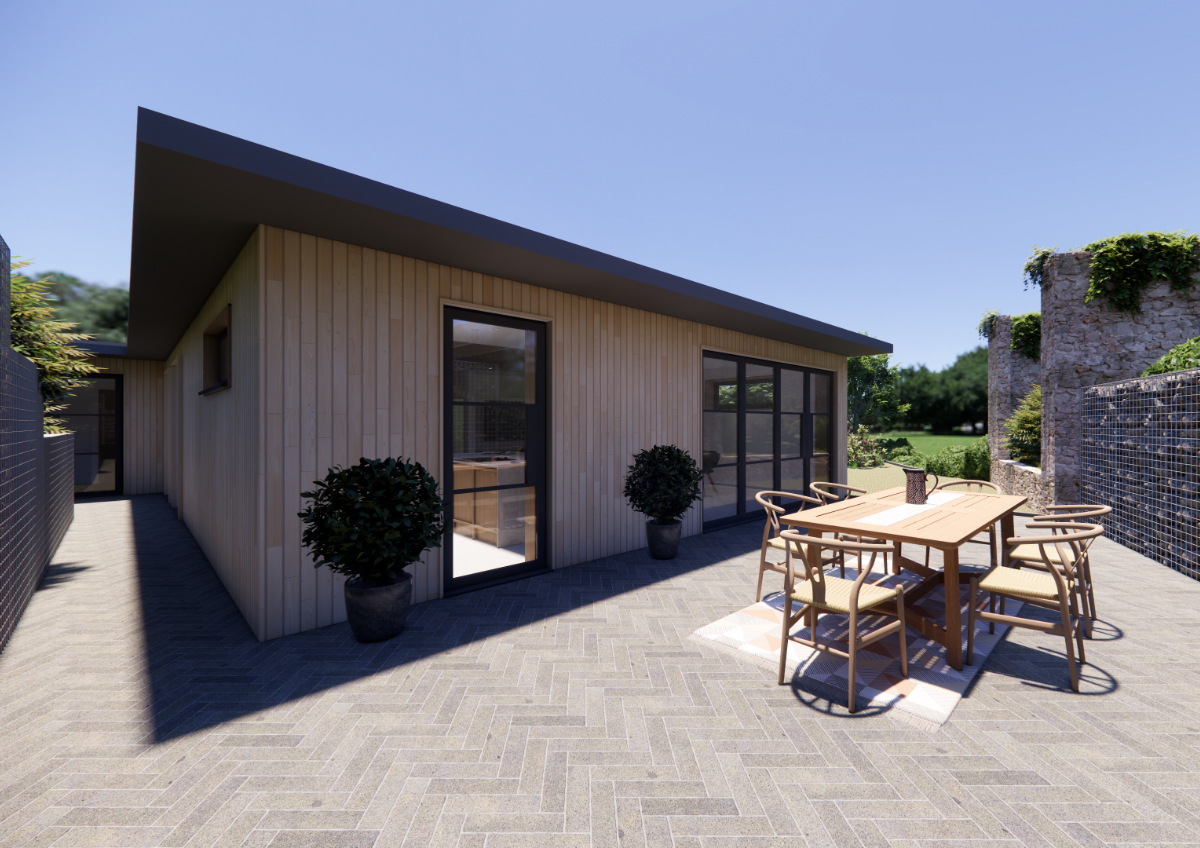
Using the Class-Q Fallback Position to create a net-zero new dwelling.
Navigating the complexities of rural development calls for a pragmatic, creative, and collaborative approach. At TEA Architects, we recently partnered with Tadman Planning Consultants on a unique project at North Hill Farm in Dunkerton, just outside Bath, to reimagine a redundant Dutch barn as a cutting-edge, net-zero home. We changed a simple farm building into a sustainable home. We did this by using the Class-Q fallback position. This process is becoming more important in rural planning.
This article outlines the innovative planning case we built for a new-build dwelling in the Green Belt and the design strategies we employed to create a high-performance home that responds sensitively to both its context and the climate.
Planning Strategy: Using Class-Q as a Springboard
Class Q of the Town and Country Planning (General Permitted Development) Order 2015 allows for the conversion of agricultural buildings into dwellings, often without the need for full planning permission. At North Hill Farm, a Class-Q approval had already been secured to convert the Dutch barn into a one-bedroom home.
This prior approval was pivotal. It established the principle of residential use on the site, creating a legitimate “fallback position” in planning terms. With this in place, we could confidently explore a more thoughtful and ambitious alternative: a full replacement dwelling.
Ordinarily, proposing a new-build home would be considered inappropriate development within the Green Belt. However, our established fallback position became the cornerstone of our argument for “very special circumstances,” which are required to justify such development. We argued that the clear benefits of our new home are better design, high energy efficiency, and good fit with the landscape. These benefits are much greater than the small harm caused by new construction. The case law of Mansell v Tonbridge and Malling made our position stronger. It confirmed that an existing Class Q consent is an important factor. This factor must be given significant weight in favour of a replacement plan. This is the Class-Q fallback position.
The Design Response: Sustainability as a Driver
Once the planning route was established, our architectural focus turned to delivering a home that would do far more than simply comply with policy. The goal was to embody the highest standards of sustainable design. The existing Dutch barn, while structurally sound, presented significant limitations. As a tall, open-sided structure, converting it would have resulted in a home with compromised energy performance, vast wasted roof space, and an awkward internal layout. Achieving a true net-zero standard within its confines would have been incredibly challenging, if not impossible.
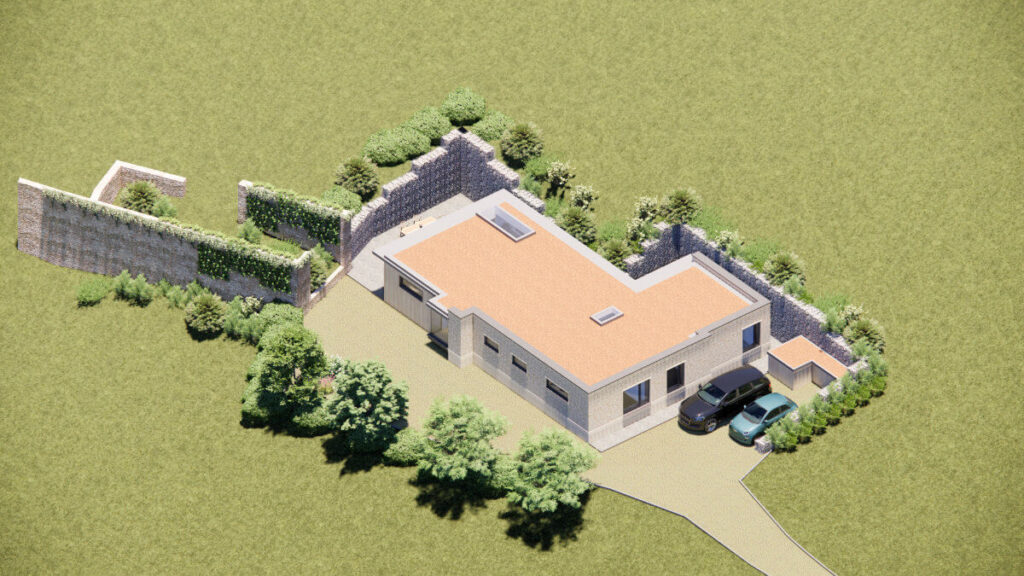
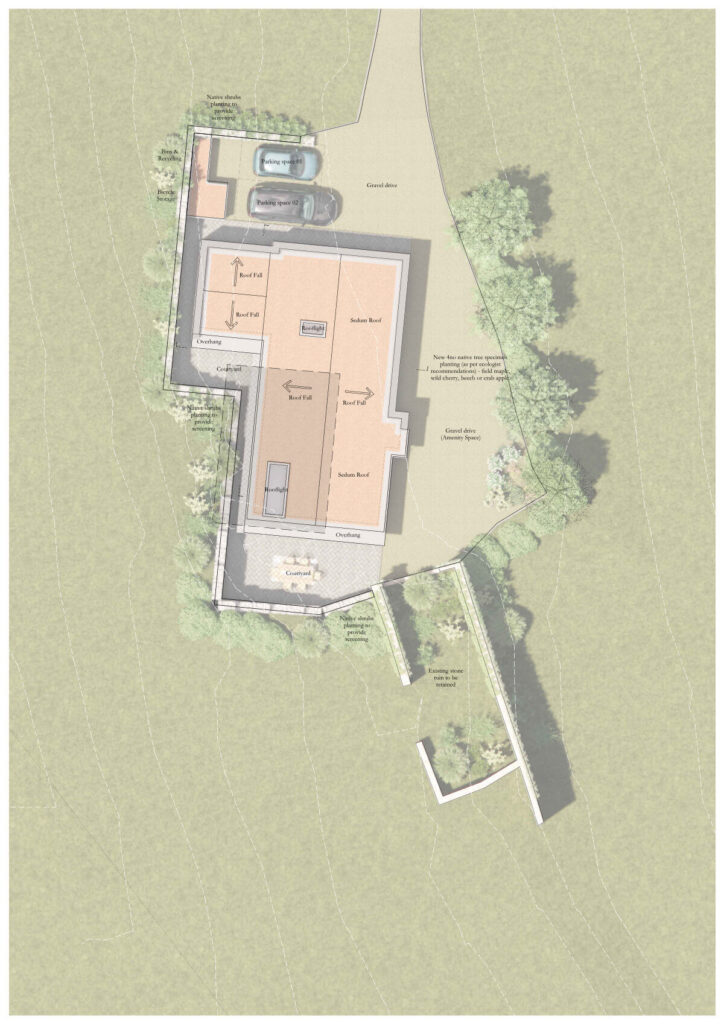
Our new design proposes a single-storey, three-bedroom dwelling built to the highest sustainable construction standards. The proposed home will:
- Achieve zero operational emissions, in line with Policy SCR6 of the Local Plan Partial Update.
- Utilise passive design principles, including optimal solar orientation, strategic shading, and natural ventilation to minimise energy needs.
- Incorporate renewable energy technologies, such as a large photovoltaic array and an air source heat pump.
- Feature high-performance insulation and airtight detailing to ensure minimal heat loss and maximum comfort.
A sedum green roof and a native planting scheme reinforce this environmental agenda, enhancing local biodiversity while helping the structure merge visually with the surrounding hillside. The home’s smart systems will monitor performance in real-time. They track energy generation and use precisely. This allows constant improvement towards the net-zero goal.
Sensitive Siting in the Landscape
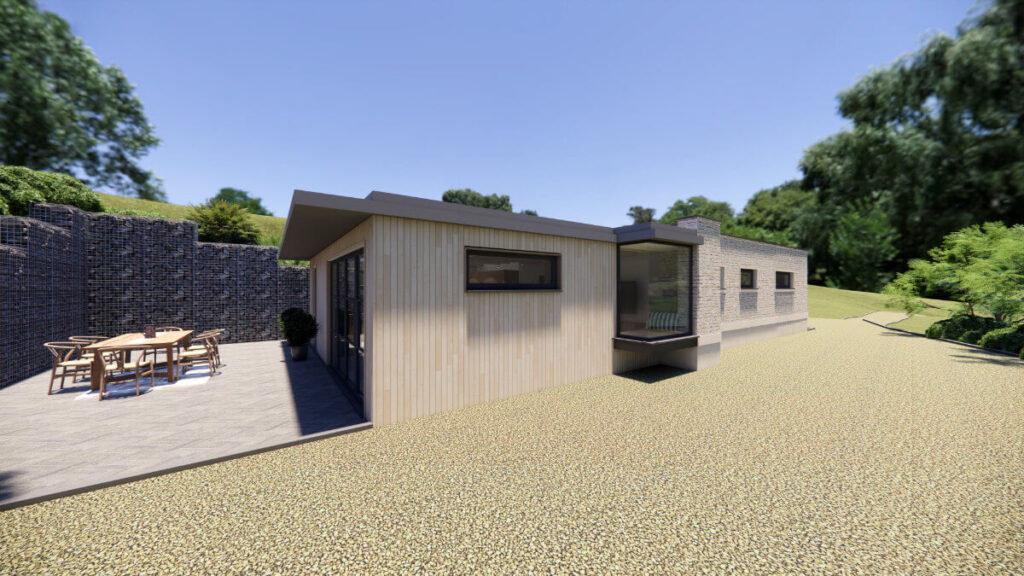
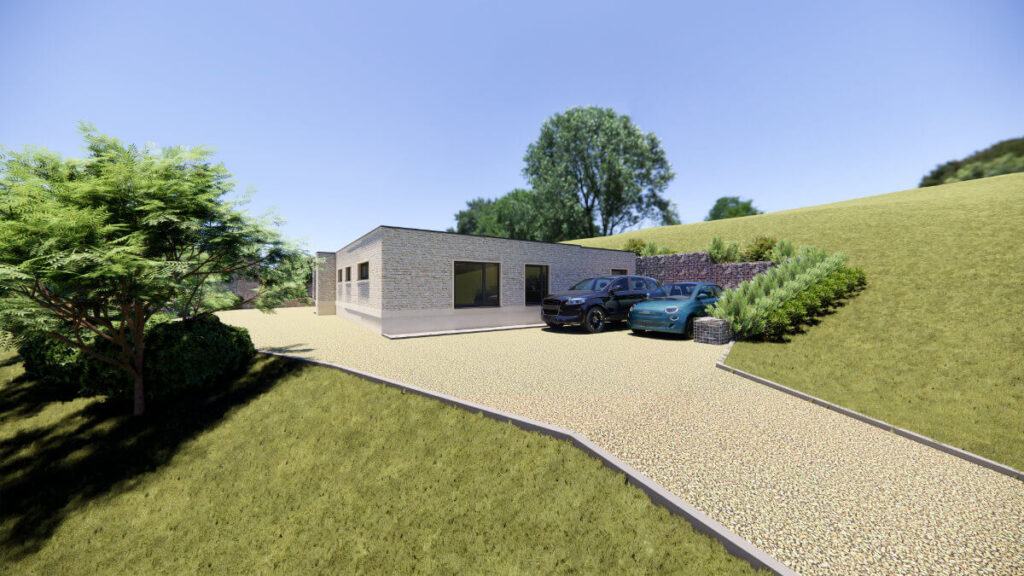
The new dwelling is deliberately designed to sit low in the landscape, significantly lower than the towering profile of the original barn. It is partially cut into the sloping terrain, a design choice that not only reduces its visual prominence from nearby footpaths and hillsides but also firmly roots the home within its rural context.
Materials were carefully selected to echo the site’s agricultural heritage and natural surroundings. The use of local rubble and ashlar stone, complemented by timber cladding and minimalist detailing like parapeted eaves, strikes a balance between contemporary form and traditional character. While the building is unapologetically modern, it feels very much of its place. Vehicle parking is placed to the side of the house on the existing concrete apron. This reduces its visual impact. The wider landscape will be restored and improved with new native tree planting and other ecological enhancements.
Enhancing Ecology and Mitigating Impact
Although self-build projects of this scale are exempt from formal Biodiversity Net Gain (BNG) requirements, ecological considerations were integral to the scheme from its inception. We viewed the project as an opportunity for genuine environmental stewardship.
Proposed ecological enhancements include:
- Two bat boxes installed on the adjacent existing stone barn.
- Three swift bricks integrated into the fabric of the new dwelling.
- Extensive native planting to create valuable habitat and soften the building’s edge.
- Careful management of the adjacent public right of way to improve accessibility and protect the local environment.
By using these features with sustainable building methods, the proposal gains more biodiversity. It also creates a thoughtful, balanced relationship with the larger site.
Planning Balance on the Class-Q fallback position
While the development is, by definition, “inappropriate” in the Green Belt, the planning balance clearly weighed in favour of the proposal. The local authority agreed that the very special circumstances were compelling:
- The Class Q fallback established the acceptability of residential use and provided a credible, albeit inferior, alternative.
- The proposed dwelling offers a significantly higher-quality outcome, both functionally for its occupants and visually for the public realm.
- The scheme actively reduces the impact on the landscape by lowering the building’s profile and nestling it into the terrain.
- Substantial sustainability benefits, including net-zero operational performance, are delivered, aligning with local and national climate goals.
- Verifiable ecological and amenity gains are achieved through thoughtful landscaping and integrated design features.
In summary, the North Hill Farm project shows how Class Q can be more than a simple planning tool. It can be a strategic way to enable better architecture and more sustainable results. It highlights how rural projects can meet and even exceed ambitious sustainability targets when freed from the constraints of retrofitting old, inefficient buildings.
Final Thoughts on the New Dwelling & Class-Q fallback position
This project shows how careful planning, fitting design, and strong commitment to sustainability can work together. They can change an unused rural site. At TEA Architects and Tadman Planning, we believe these values are essential as we work to create homes that are not only permissible but are genuinely positive and lasting additions to our landscapes.
If you’re exploring a similar project, whether through Class Q or another route, we’d love to help you realise its full potential. Please get in touch to discuss your vision.
Rachel Tadman | Tadman Planning Consultants
rachel@tadmanplanning.co.uk | 07776 132225 | www.tadmanplanning.co.uk
Ewan Tavendale | TEA Architects
ewan@tea-architects.co.uk | 07890 904378 | www.tea-architects.co.uk